
Applicazioni > Slab detection on outdoor roller tables
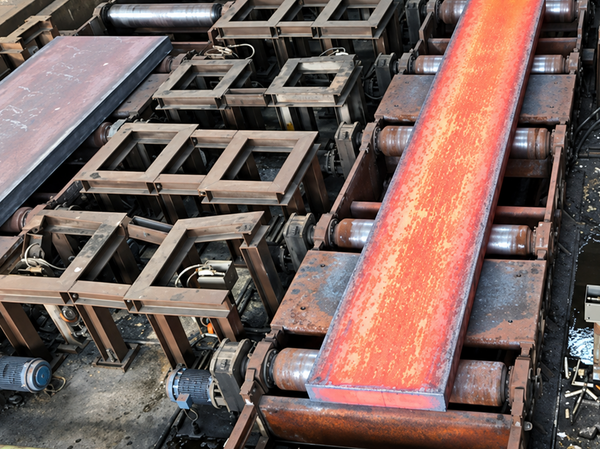
Slabs may be glowing hot or completely cooled down. On outdoor roller tables in particular, radiant heat, rain, snow, sunlight, fog, steam, frost, scale and contamination make reliable material detection challenging. For this demanding task, Proxitron generally recommends a powerful through-beam sensor from the LX_600 series. It detects the interruption of the light beam, making detection largely independent of the slab’s temperature, colour, gloss and surface condition.
Typical applications
Slab detection, slab presence sensing and slab tracking are required wherever steel mills automatically transport or position material on outdoor roller tables, or transfer it to the next process stage. Indoor applications may involve different operating conditions and can be assessed separately.
- Furnace exits and entry roller tables in hot rolling mills
- Outdoor roller tables, slab storage areas and cooling sections
- Continuous casting plants and areas downstream of flame cutting
- Transfer stations, transfer cars and cross-cutting sections
- Cold processing areas, inspection, sorting and dispatch
Challenges in slab detection
Sensors on outdoor roller tables must withstand intense radiant heat, persistent moisture, direct sunlight, frost, major temperature changes and poor visibility. Hot slabs can reach temperatures of up to 1,000 °C. The actual thermal load on the sensors also depends on slab dimensions, distance, transport speed and possible standstill periods. Deposits on optical surfaces must not compromise detection without being noticed.
Consequences of incorrect detection
If a slab is missed, detected too late or detected at the wrong position, this can lead to incorrect roller table enable signals, faulty material transfers and interruptions to production. Depending on the function of the installation, collisions, damage to downstream equipment or unplanned downtime may also occur. Reliable presence and position detection therefore helps maintain controlled material flow.
Recommended sensor solution
Proxitron LX_600 through-beam sensors provide very high optical power and a range of up to 2,500 m, delivering substantial optical excess gain over shorter distances. The transmitter and receiver face each other, and the slab interrupts the light beam. Detection relies neither on reflected light nor on the material’s own thermal radiation. Depending on the heat exposure, compact uncooled, water-cooled or fibre-optic versions are available. A combined configuration is also possible if one side of the roller table is exposed to a particularly high thermal load.
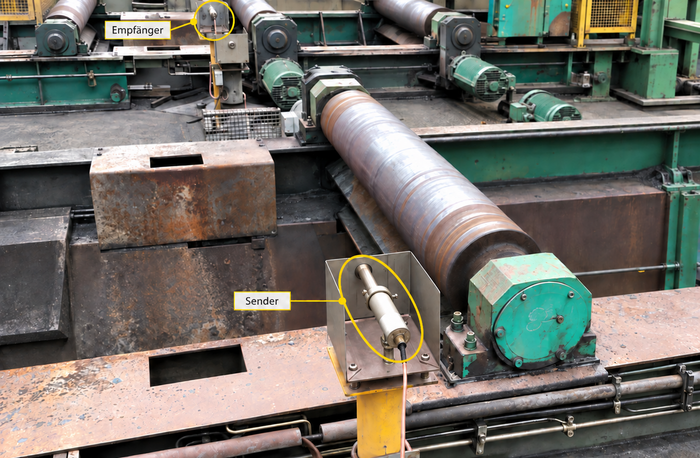
Proxitron high-performance through-beam sensors for demanding outdoor environments
The LX_600 series combines high optical power with a rugged design developed for the steel industry. Its durable stainless steel housing supports operation in moisture, dirt and changing outdoor temperatures. A wide range of adjustment options makes it easier to adapt the sensors to the beam path and operating conditions. A contamination warning or signal reserve monitoring function can provide early warning of decreasing excess gain before slab detection is affected. Other Proxitron sensor solutions may also be suitable, depending on the installation and detection task. This application report focuses on the LX_600 series as a particularly robust solution for outdoor slab detection.
Diagnostics before failure
Suitable Proxitron models can report decreasing signal reserve and elevated device temperature to the plant control system at an early stage. This allows cleaning, inspection or cooling system checks to be arranged before reliable slab detection is compromised. These diagnostics support condition-based maintenance and reduce unplanned interventions.
Accessories and protective measures
Depending on the installation, protective tubes, cooling systems, fibre-optic cables, high-temperature optics, mounting brackets and additional protective devices may be required. Proxitron accessories reduce heat exposure, protect optical surfaces and help maintain stable transmitter and receiver alignment over time. For water-cooled versions used outdoors, the cooling lines and coolant must also be protected against freezing.
| Configuration | Suitable for | Points to consider |
| Compact LX_A 600 through-beam sensor | Areas with high radiant heat and ambient temperatures up to +70 °C. | Observe the permissible device temperature, taking radiant heat into account; a protective tube can reduce heat exposure. |
| Water-cooled LX_B 600 through-beam sensor | High radiant heat and ambient temperatures up to +200 °C. | Ensure a reliable cooling water supply; protect cooling lines and coolant against freezing when used outdoors. |
| LX_D 600 through-beam sensor with fibre-optic cable and high-temperature optics; combined configuration | Areas where cooling is unavailable. Fibre-optic cables and optics up to +290 °C; suitable optics can withstand up to +600 °C on the optical side under extreme conditions. Different thermal loads on the two sides of the outdoor roller table. | Allow for lower optical excess gain than with compact devices when designing the system. Match the compact device and the fibre-optic side to the beam path and installation conditions. |
Advantages
Proxitron LX_600 through-beam sensors detect hot and cold slabs largely independently of colour, mattness, gloss and scale. Their very high optical power provides substantial excess gain in dirt, rain, snow, sunlight, fog and steam. Robust stainless steel housings, extensive adjustment options and diagnostic functions for monitoring signal reserve and device temperature support reliable outdoor operation. Fibre-optic cables enable use in particularly hot areas.
Limitations
The transmitter and receiver require mounting points on opposite sides. Water-cooled systems involve additional installation work and require suitable frost protection outdoors. Fibre-optic sensors, however, reduce the available optical excess gain.
How can slabs be reliably detected on a roller table?
For reliable presence detection on outdoor roller tables, Proxitron generally recommends a powerful LX_600 through-beam sensor with a separate transmitter and receiver. The slab interrupts the light beam between the two devices. This method is largely independent of changes in material surface condition and provides substantial excess gain in adverse weather and dirty conditions.
Which sensors are suitable for slab detection?
Robust Proxitron LX_600 photoelectric through-beam sensors generally provide the greatest optical excess gain. Depending on the thermal load, compact uncooled, water-cooled or fibre-optic versions can be used.
Which sensors are suitable for hot slabs at temperatures up to 1,000 °C?
Slab temperature is only one factor. Slab dimensions, distance, speed and dwell time also determine the heat exposure of the sensors. Depending on the load, uncooled or water-cooled devices, or remote solutions with fibre-optic cables and high-temperature optics, may be suitable.
When is an uncooled through-beam sensor sufficient?
Compact uncooled LX_600 versions can operate at an internal device temperature of up to +70 °C. This temperature is affected by both the ambient temperature and additional radiant heat from hot objects. The internal device temperature can be monitored electronically, and an alarm can be generated if the limit is exceeded. The specific installation conditions should be assessed in advance.
When is water cooling required?
Water-cooled versions allow operation at ambient temperatures of up to +200 °C, subject to the effects of radiant heat. They are useful when intense radiant heat, short distances or prolonged dwell times of hot objects in front of the sensor could cause the permissible internal sensor temperature to be exceeded.
What needs to be considered regarding water cooling and frost?
For water-cooled through-beam sensors on outdoor roller tables, cooling lines and coolant must be protected against freezing. Depending on the installation, suitable antifreeze, insulated or heated lines and coolant flow monitoring may be required. The compatibility of the coolant with the cooling system must be checked.
Can a protective tube shield the sensor from radiant heat?
A protective tube fitted in front of the sensor can reduce direct heat exposure and provide additional shielding for the optical surface. Whether this is sufficient depends on temperature, distance, slab dimensions, dwell time and mounting position.
Are Proxitron through-beam sensors suitable for outdoor roller tables?
Yes. LX_600 infrared through-beam sensors are designed for demanding outdoor industrial applications. High optical power, robust stainless steel housings and diagnostic functions support operation in rain, snow, sunlight, fog, steam, frost, moisture and dirt. The specific mounting arrangement and temperature conditions must still be assessed for each application.
How does the sensor operate in steam, dust and scale?
The infrared through-beam sensor’s very high optical power ensures that sufficient usable light can still reach the receiver despite partial attenuation. Applications involving severe or persistent obstruction of the beam require an individual assessment.
Why is a through-beam sensor more suitable than a diffuse-reflective sensor?
A diffuse-reflective sensor requires sufficient light to be reflected back from the slab. Dark, matt, rough or unfavourably positioned surfaces can weaken the signal. A photoelectric through-beam sensor is largely independent of these effects.
Is aligning the through-beam sensor difficult?
No. The photoelectric through-beam sensor’s wide light cone and high transmitter power provide substantial optical excess gain even when alignment is not ideal. A clearly visible LED indicator or software display also shows when the transmitter and receiver are optimally aligned.
Why are laser sensors generally not the preferred option for outdoor roller tables?
In rain, snow, fog, steam, dirt or cases of misalignment, a narrow laser beam often provides less detection margin. The laser sensor must also be carefully protected against radiant heat from hot slabs. Depending on the laser class and installation conditions, an additional laser-specific safety assessment is required. A Proxitron infrared through-beam sensor does not require this type of laser safety assessment. General machinery and plant safety requirements still apply.
Can a compact through-beam sensor be combined with a fibre-optic solution?
Yes. A combined configuration can be useful if one side is exposed to a particularly high thermal load. One side then uses a fibre-optic cable and optics, while the other uses a compact cooled or uncooled device. This configuration significantly increases optical excess gain compared with a system using fibre optics on both sides.
What information is needed to select a through-beam sensor system?
The required information includes slab temperature and dimensions, distance from the sensors, transport speed, possible standstill duration, beam path length, environmental conditions, mounting position, mounting options, cooling water availability and the desired diagnostic functions.
Where should the through-beam sensor be mounted on the roller table?
The slab must reliably interrupt the optical axis. At the same time, the transmitter and receiver should be protected as effectively as possible against direct radiant heat, mechanical impact and persistent deposits, while remaining accessible for maintenance.
Broschüren
 PDF herunterladen
Anwendungsfragebogen Lichtschranken
 PDF herunterladen
Proxitron Lichtschranken LX
 PDF herunterladen
Proxitron Lichtschranken
 PDF herunterladen
Proxitron Laser Lichtschranken LLX
 PDF herunterladen
Proxitron Einweg-Lichtschranken M40
 PDF herunterladen
Proxitron Einweg-Lichtschranken M40 LLK
 PDF herunterladen
Proxitron Lichtgitter
Have your slab detection application assessed
Every outdoor roller table has different requirements regarding beam path length, optical excess gain, weather protection and thermal design. Proxitron works with you to determine which LX_600 version and accessories are suitable for your specific installation.
Information required for an application assessment
- Maximum and typical slab temperature
- Slab dimensions and position on the roller table
- Distance between the slab and the sensors
- Transport speed and possible standstill duration
- Required beam path length between transmitter and receiver
- Outdoor conditions, including exposure to rain, snow, sunlight, fog and frost
- Steam, dust, scale and other obstructions to visibility
- Mounting options on both sides of the roller table
- Availability of water cooling
- Frost protection and monitoring of the cooling water supply
- Required diagnostic and warning functions
Contact us by phone on +49 4121 2621-0, by email at sales@proxitron.de or via our contact form.
Go to our through-beam sensor application questionnaire >>